The Big Picture: Bi-Coastal Cat Fight
What's the difference between East and West Coast go-fast catamarans? Everything.
November 1, 2009
As I’ve mentioned in this column, the fastest I’ve gone on the water is 168 mph in a high-performance catamaran. Of course I wasn’t driving. I was praying—anyone can find religion in the right moment. Bob Teague and John Tomlinson were handling the steering and throttling chores.

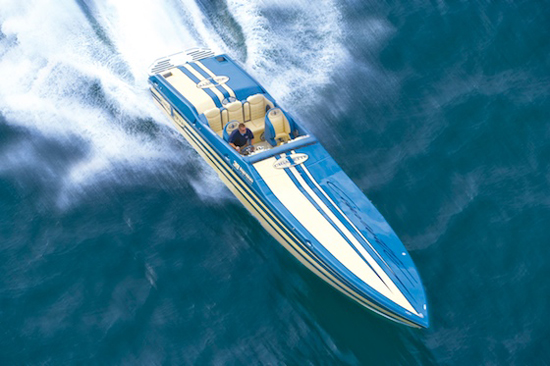
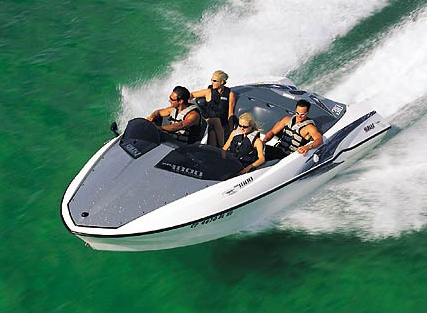
Designed for on lakes and rivers, the Eliminator 28 Daytona is the epitome of a West Coast custom catamaran.
Oddly enough, when I tell people about this experience they don’t question the speed or even that, if they know me, I prayed. Instead, they question the vessel. They’ve never heard of a high-performance “power” catamaran. That’s because to the average guy or gal in the street thinks a catamaran is sailboat. But there’s an entire obscure world out there of go-fast cats.
Or make that two worlds. There are West Coast cats and East Coast cats and though they share roughly the “same” basic, efficient and speed-producing bottom design—two sponsons flanking an air-entrapment tunnel—that’s where the similarities end.
Let’s start with function. Take, for example, a 36-foot-long Skater cat from Douglas Marine in Douglas, Mich. (for some reason, don’t ask me why, Douglas is considered an “East Coast” builder). Thanks to tall sponsons, a deep tunnel and rock-solid construction, a Skater 36 can make short work of rough offshore water. And yet rough offshore water would make short work of, let’s say, a 36-foot Daytona cat from Eliminator in Perris Valley, Calif. That isn’t a knock on the Daytona—the cat is simply designed and built to handle river and lake conditions.
Sticking with the Skater and Eliminator comparison for a moment, it’s fair to say that Douglas Marine builds a stronger cat—as it should, based on intended use and builder output. In a big year, the company produces 30-plus Skater cats. In that same big year—and rest assured this isn’t the year—Eliminator might build almost 300 cats. As you’d expect, Douglas Skater cat prices are a tad higher than—think double—Eliminator Daytona cat prices.
These cats are representative market leaders in their regions, although there’s plenty of variation among builders in both areas. The most graphic differences—and I do mean graphic—between East and West coast cats are, well, graphics.
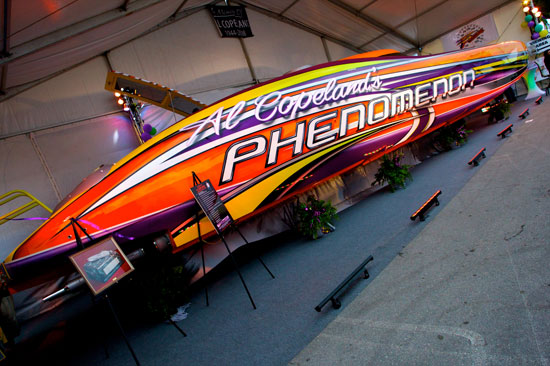
East Coast cats are painted. West Coast cat graphics are created in colored gelcoat, which is the first ingredient (and serves as a release agent from the molds) in the lamination recipe of most boats. To create gelcoat graphics, gelcoat is applied in reverse so that when the hull and deck are pulled from the inside of their female molds the graphics will be “right side out,” so to speak. No doubt, there’s an art to it.
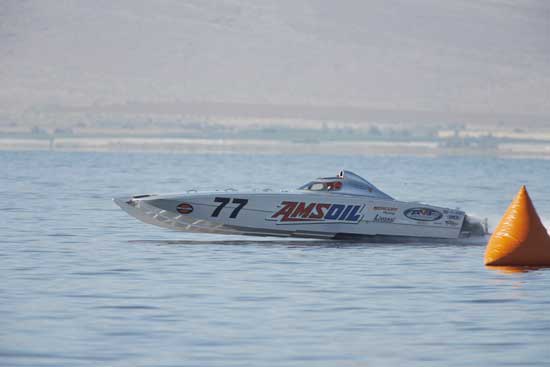
Dressed for offshore racing, this "East Coast" 36-foot Skater is among the best of the catamaran breed when it comes to handling rough water.
If you’re confused, don’t worry about it. The real differences are in the motifs—the East and West Coast genres if you will—because gorgeous graphics can be created with either paint or gelcoat.
Here’s the deal: West Coast graphics tend to be about vibrant colors, which is one of gelcoat’s strongest qualities. I’m not talking about subtle hues. I’m talking about color combos on the order of, “The guys at Ringling Brothers called. They want their catamaran back.”
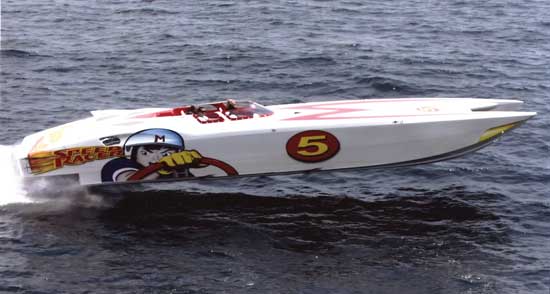
The 44 MTi "Speed Racer" catamaran, owned by Bob Christie, is a perfect example of what can be done with paint rather than gelcoat.
East Coast cat graphics tend to be all about images, presentational or representational, mural-style if you will. That’s because paint allows for greater detail than gelcoat. That’s why some East Coast cat paint jobs cost more than $60,000 and blow minds with their intricacy. That’s also why it’s far more likely you’ll find a naked lady painted on the deck of an East Coast catamaran than on the deck of a West Coast catamaran.
Now, I’m not judging, though I have always wanted to ask those clowns (OK, I’m judging) who have naked lady images on anything they own, “Does that really work for you?” I’m just explaining differences in aesthetic sensibilities. Beauty is in the eye of the beholder. One man’s Monet is another man’s Kincaid. Or something like that.
There is no “best” here. There is only what’s best for your needs, taste and budget. Make of that what you will.
But do not mistake an East Coast cat for a West Coast cat. For they are, after all, completely different breeds.